
Asking about your data
Name the measurement and the period in your question. Growi looks for the measurement in the modules of your crop and answers with the values it read. Without a period it reads the last 24 hours, or the last 7 days for a measurement that only has daily values, such as RTR or a crop registration.
Ask about a value
Section titled “Ask about a value”- Type the question with the measurement and the period: “What was the lowest night temperature this week?”
- Pick the crop when Growi shows the crop card. See Choosing a crop.
- Name the period again in a follow-up. Growi keeps the crop, not the period: “and the humidity?” is answered for the last 24 hours.
- Ask “why?” when you want the cause. Growi then reads the outside weather for the same period first, and after that ventilation, screens, heating and CO2 dosing.
Growi compares your words with the names of the measurements in your crop. The exact name as LetsGrow has it, or the item code, selects that measurement directly. Dutch words work too, such as “kastemperatuur” or “RV”.
| You say | Growi takes |
|---|---|
| Only “temperature”, “humidity”, “RH” or “CO2” | The greenhouse value |
| Only “EC” | The substrate value |
| “Setpoint”, “target” or “desired” | The setpoint. Without such a word Growi prefers the measured value |
| “Day” or “night” | The day value or the night value of the same measurement |
| “Last night” | The values between 18:00 and 06:00 of the last finished night, not the night value. A value that LetsGrow records once a day, such as dry-back, comes with its date instead |
| “VPD” | VPD plant. Ask for VPD greenhouse when you want that one |
| “Dry-back” or “dryback” | Dry-back in kg. Say “dry-back %” for the percentage |
| “Outside radiation” | The radiation of your weather station |
The day, night and 24-hour values are explained in the Glossary.
Name a period
Section titled “Name a period”Growi understands today, yesterday, last night, the last 24 hours, this week, last week, this month, last month, this season, a number of days back, a month name, a week number, a date, a range between two dates and a year. A week runs from Monday to Sunday. “June” means the most recent June. “This season” runs from the planting date of the crop to its end date, or to now while the crop runs. Today, this week and now are reckoned in your own time zone.
A number of days back or a date range reaches at most 5 years back. A period that is still running, such as today or this week, gets an answer that says the figures are not final.
Compare two periods
Section titled “Compare two periods”- Make sure one crop is active. With two or more crops Growi compares the crops and ignores the second period.
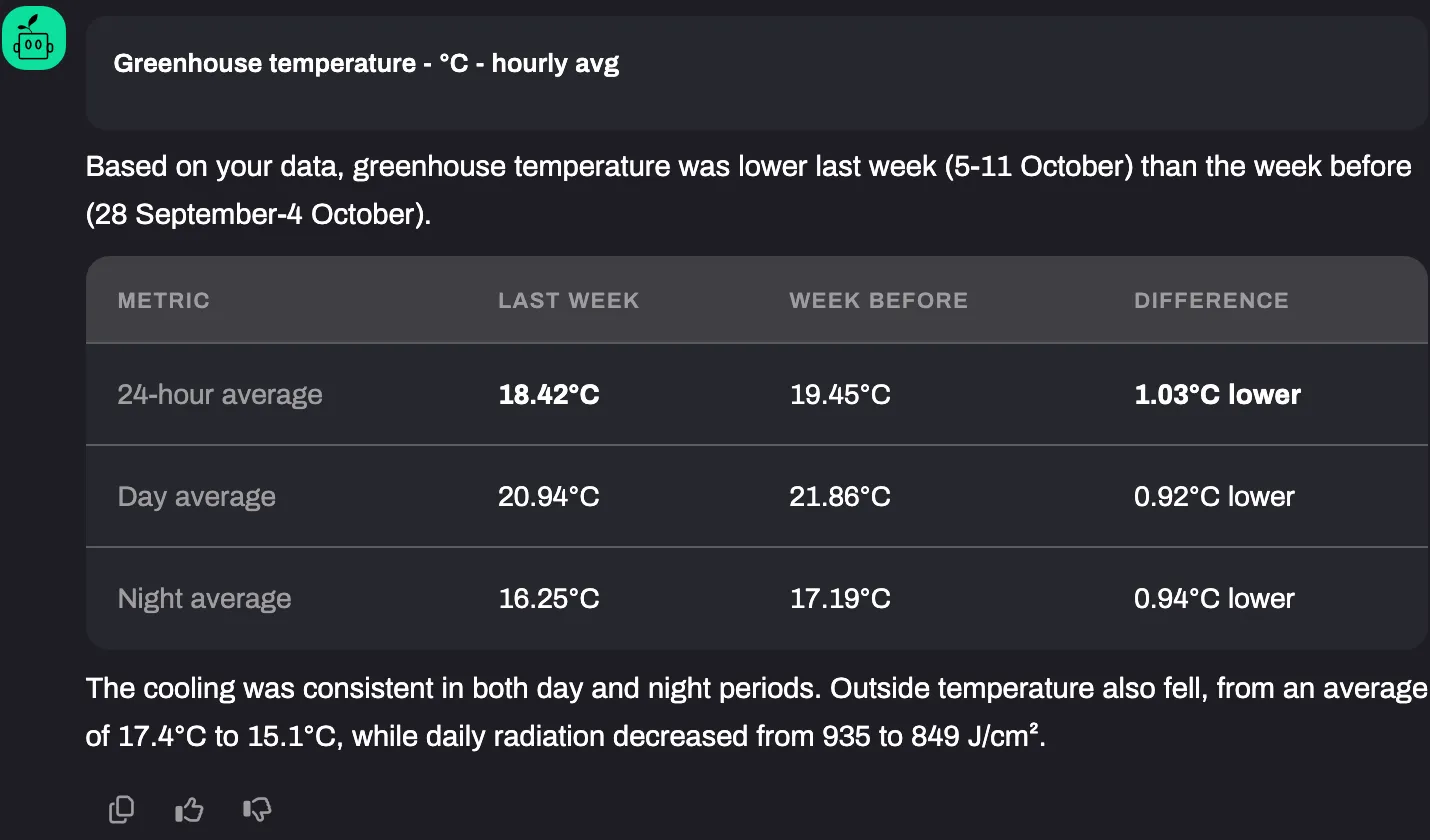
- Name one measurement and both periods: “Compare the greenhouse temperature of last week with the week before.”
- Ask “why?” for the cause. Growi gives the difference and its direction, and looks for the cause only when you ask.
A week is compared with a week that starts on the same weekday, so day and night line up. Months keep their own length: June against May is 30 days against 31. When a period starts before the start date of the crop, Growi adds that those values may belong to a previous crop.
Expected result
Section titled “Expected result”An answer with the values, and a line chart when Growi read at least 4 points. A comparison gives one chart with the two periods laid over each other, each labelled with its name and exact dates.
Troubleshooting
Section titled “Troubleshooting”- Growi used another measurement than you meant, or found no data. See When an answer looks wrong.
- You don’t know what the crop measures. Ask “Which data does this crop have?”. Growi lists the measurements per module, at most 30 without a keyword. Add a keyword to narrow it down.